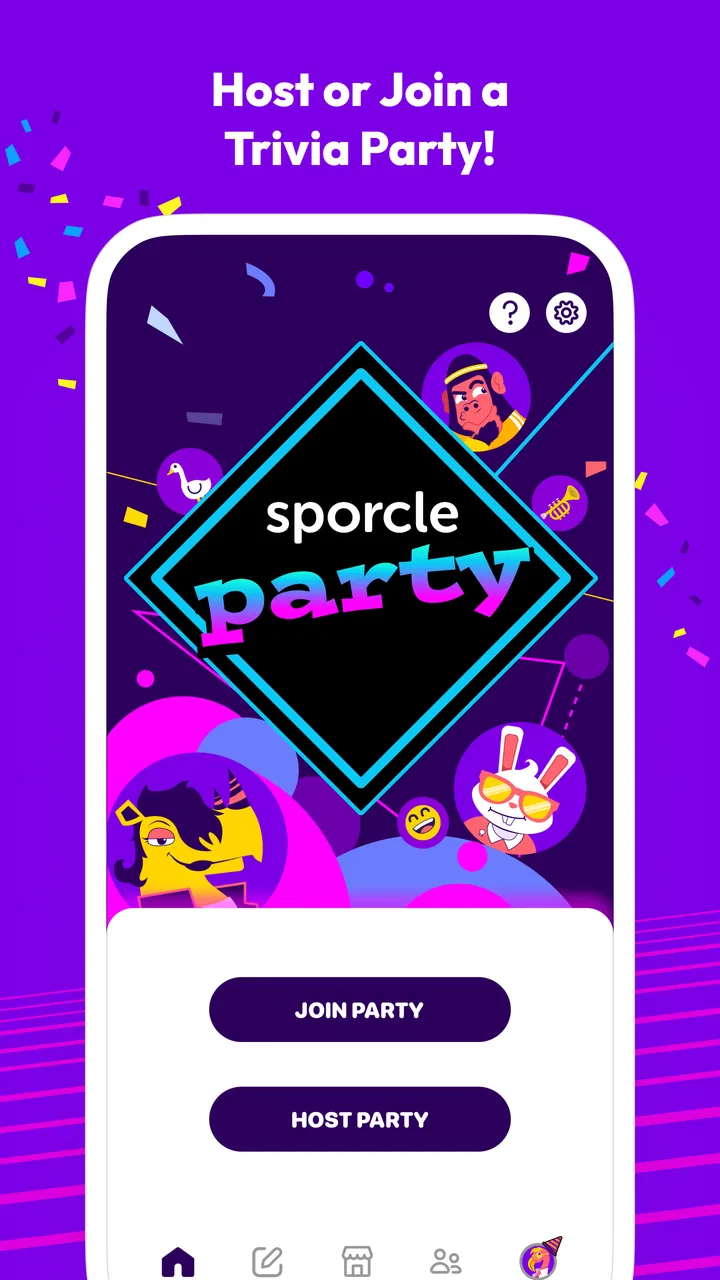
Sporcle Party: Social Trivia
- 4.2
- Rating
- 5.00M
- Installs
- Free
- Price
 Analysis by App-foxy
I enjoy trivia most when it creates a little friendly chaos rather than turning into a solitary test. That is the space Sporcle Party tries to fill: it is a free social trivia game from Sporcle, Inc., built around playing with friends instead of quietly answering questions alone. After spending time with it, I found the appeal easy to understand. It is quick to start, familiar enough for casual players, and more entertaining when everyone in the room is willing to argue about an answer.
That does not make it the perfect choice for every quiz fan. Its strongest quality is the shared moment, not a deep single-player progression system. If you want a carefully structured study tool, a long campaign, or a trivia app that rewards private practice above all else, another option may suit you better. If you want something to pull out during a relaxed gathering, however, this is a much more natural fit.
How the current version feels in everyday play
The basic idea is straightforward: gather friends, choose a quiz, and compete through questions together. That simplicity matters because party games often lose their audience before the first round begins. Here, the familiar trivia format gives newcomers an immediate entry point. Nobody needs to learn a complicated ruleset before contributing, and experienced quiz players can focus on speed, memory, and the occasional lucky guess.
You May Also Like

 Blood Strike: 2.5 Anniversary
Blood Strike’s Loadouts Turn Every Drop Into a Tactical Gamble
A close look at Blood Strike’s custom loadouts: how fast access to signature weapons reshapes its battle royale rhythm, rewards preparation, and narrows the gap between fights.

 Pandora - Music & Podcasts
Pandora’s Music Is Easy to Start, but Harder to Recover
Pandora’s strength is its low-effort path from a seed to a station. Its weak spot is how much confidence it asks you to place in connection, setup, and quiet recovery.

 8 Ball Pool
 Is Built on Rivalries, Rematches, and Routine
A close look at the rivalries, rematches, shared routines, and unanswered safety questions that turn a quick pool match into a persistent mobile community.

 Samsung Music
’s Quiet Strength Is Playing What You Already Own
Its reach comes less from spectacle than from dependable access to a personal library. That simplicity is both the app’s strongest retention engine and its ceiling.

 AccuWeather: Weather Radar
AccuWeather Review: A Quick, Clear Forecast for Everyday Decisions
For everyday plans, the best forecast is the one you can understand quickly. AccuWeather makes rain timing, radar, and local conditions easy to act on, with a few trade-offs.

 Hill Climb Racing
Why Hill Climb Racing Still Turns Crashes Into One More Run
A tiny car, a bumpy hill and one more upgrade: Hill Climb Racing keeps resurfacing because its simple chaos makes every near-miss feel personal.
More From Our News Desk



I would describe the tone as sociable rather than intensely competitive. The game works best when players are comfortable laughing at wrong answers and challenging one another’s confidence. A person who knows a lot about films, geography, music, or general knowledge can have a strong advantage, but the group setting softens that imbalance. Even a player who rarely wins can still become the person who recognizes an obscure clue or talks everyone into an unexpectedly correct response.
One practical strength is how easily it can fit around an existing plan. I can imagine using it after dinner, while waiting for friends to arrive, or during a low-key evening when nobody wants to commit to a full board game. It does not demand the same preparation as a traditional quiz night. The phone becomes the prompt for conversation, while the people around it provide the real entertainment.
The experience is less convincing when treated as a serious test of knowledge. Party trivia is naturally affected by interruptions, different levels of attention, and the fact that some participants may be answering from a shared screen or discussing possibilities aloud. That is not a flaw in the concept, but it means the result should be viewed as a fun contest rather than a precise ranking of intelligence.
The game is free to install, with optional purchases ranging from $0.99 to $6.99 per item. That makes trying it relatively easy, especially for a group that is unsure whether a mobile quiz game will become part of its routine. I would still decide in advance whether everyone is comfortable with optional spending, particularly if the phone will be passed between several people.
What makes the group format work
The most important preparation is not technical; it is social. I get better results when one person takes responsibility for starting the session and explaining the rhythm before the first question. That prevents the familiar party-game problem where half the group is still figuring out what to do while the other half has already begun competing.
A second useful habit is to treat the first round as a warm-up. People often need a few questions to understand how specific the quiz topics are and how seriously the group wants to play. Starting with a relaxed attitude also helps mixed-age groups, especially because the content rating is Everyone 10+. Younger players may enjoy it, but I would still choose quizzes and discussion topics with the actual group in mind rather than assuming every subject will suit everyone.
There is also a subtle trade-off between speed and conversation. If players debate every answer at length, the game becomes a social discussion with trivia attached. If everyone rushes, quieter participants can disappear. I prefer allowing a short pause after difficult questions so less confident players have room to contribute. That small adjustment makes the app more welcoming without changing its central competition.
Useful ways to use it beyond a casual match
One of the better uses is as a low-pressure icebreaker. At a gathering where not everyone knows one another, trivia gives people a reason to speak without forcing personal introductions. I would choose broad subjects rather than highly specialized ones, then let the answers lead into conversation. A question about a place, song, or historical event can easily become a story about travel, childhood, or a shared interest.
It can also work as a short reset during a long evening. Instead of planning an entire tournament, I would play a small session between other activities. This avoids one of the common weaknesses of party games: once the novelty fades, the group feels obligated to continue. Using it in brief bursts preserves the energy and makes it easier for people to leave or rejoin.
For families, I would use it as a conversation starter rather than a classroom replacement. The game may encourage children and adults to compare what they know, but it is not the same as a structured learning app. A parent who wants reliable lessons, explanations, or a carefully controlled curriculum should look elsewhere. The value here is shared recall and playful disagreement.
Another less obvious approach is to use the game to reveal gaps in a group’s assumptions. Friends often believe they have identical interests until a quiz exposes very different strengths. One person may dominate a topic while another performs better in a category nobody expected. I find that more interesting than simply watching the highest score, because it changes how the group chooses future quizzes and teams.
Evolution, version context, and what it means for players
The current release is version 1.5.11, while the game first appeared on April 9, 2020. That history suggests a product that has had time to establish its identity rather than arriving as a brand-new experiment. I would not interpret the version number alone as proof of a particular feature or major redesign, but it is useful context: players are approaching an established social quiz experience, not an unreleased concept.
For existing users, the practical question is whether the current build still supports the way they like to play. In my view, its core promise remains clear because the game does not need elaborate systems to create a good round. The important test is whether your group enjoys the available quiz style and can comfortably organize play around a phone. If that answer is yes, the current version has a solid reason to stay installed.
New users should approach it with realistic expectations. A mature party game can feel dependable, but it may also seem less surprising than a constantly changing live-service title. I would install it for the social format first, not because I expect a dramatic transformation every time I open it. The version information is reassuring as a sign of ongoing product maintenance, while the actual enjoyment still depends on the people playing.
Its popularity gives some useful perspective. The game has passed one million installs and holds a 4.4 average from roughly fifteen thousand ratings. Those figures do not guarantee that every group will enjoy it, but they do indicate that the concept has found a substantial audience. I take that as evidence that the basic social loop is understandable and appealing, not as a reason to ignore its limitations.
Where it falls short compared with other trivia choices
Compared with a conventional solo quiz app, this game is less attractive when I want quiet repetition. A solo alternative may be better for building a daily habit, revisiting mistakes, or measuring personal improvement without waiting for friends. Sporcle Party is at its best when answers become part of a shared exchange, so opening it alone removes much of its personality.
Compared with a board-game-style trivia box, it is more convenient and easier to carry, but it may feel less tangible. Physical games often provide a stronger sense of occasion through cards, tokens, and a visible board. They can also make turn order and scoring easier for a group to see. The mobile format wins on portability, while the tabletop format may win when everyone wants a longer, more deliberate event.
Compared with a competitive online trivia platform, this title feels more suited to people who already have a social connection. Online competitors can provide a larger pool of opponents and a more formal sense of ranking. That can be exciting, but it can also make the experience feel anonymous or stressful. I prefer Sporcle Party when the goal is to entertain friends in the same setting rather than prove myself against strangers.
There is a further trade-off around purchases. The free entry point is helpful, but optional items can complicate the feeling of a completely open party game. I would not let that stop me from trying it, yet I would keep spending separate from the social pressure of the match. A game is more enjoyable when nobody feels they need to buy something simply to keep up with the group.
Who should play, and who should skip it
I recommend it to friends who enjoy general trivia but do not want to organize a formal quiz night. It is also a good candidate for families with older children, casual gatherings, and players who like discovering unexpected strengths among their friends. The Everyone 10+ rating gives families a useful starting point, although adults should still use judgment about the subjects selected and the atmosphere of the group.
I would be more cautious recommending it to someone who mainly plays alone. You can still explore the quiz concept, but the title’s identity is built around shared play, so a solo user may find it less satisfying than a dedicated knowledge-training app. I would also point serious tournament-style players toward a more structured alternative if they need highly formal scoring, carefully balanced competition, or a persistent competitive ladder.
People who dislike timed pressure or public wrong answers should think about the group they plan to play with. A supportive circle can make mistakes funny and harmless; an overly competitive circle can make the same mechanics uncomfortable. That is not something a software update can solve. The best way to improve the experience is to agree on the tone before starting and make room for players who need a little more time.
Questions I would settle before installing
Is it genuinely free to try? Yes. The game is free, although optional purchases are available. I would begin without buying anything, see whether the group actually returns to it, and only then consider spending. That approach keeps the first session focused on the gameplay rather than the store.
Can it replace a learning app? Not in my opinion. It can encourage recall, curiosity, and conversation, but I would not rely on it for lessons or systematic study. Someone preparing for an exam needs explanations, organized material, and progress tracking designed for that purpose. This is entertainment first.
Does it suit children? Its age rating is Everyone 10+, so it is positioned for a broad audience that includes older children. I would still supervise the first session with a mixed-age group, especially if the players have different comfort levels or the quiz topics vary widely. The rating is a useful guide, not a substitute for knowing your audience.
What device support is needed? The game requires Android 6.0 or later. That is helpful for people using older compatible phones, though I would still make sure the device is comfortable for group viewing and that the battery is not already low before starting a long session.
How much should I trust the public response? The combination of over one million installs, a 4.4 average, and around fifteen thousand ratings suggests broad satisfaction, while the listed eighty-seven reviews offer additional written feedback to consider. I treat those signals as a starting point, not a guarantee. The decisive question is whether your friends enjoy answering together.
What I would watch in future use
For returning players, I would watch whether the game continues to feel fresh after the first novelty fades. Social trivia depends on variety, but it also depends on the group’s willingness to keep inviting it into their plans. The strongest sign of long-term value is not a single exciting round; it is whether people suggest playing again without being prompted.
I would also pay attention to how well the experience handles mixed groups. A good party title should let knowledgeable players feel challenged without making newcomers feel irrelevant. If the same people dominate every session, changing the quiz selection, forming teams, or lowering the emphasis on winning may matter more than any feature change.
Finally, I would keep an eye on the balance between the free experience and optional purchases. The free version is the reason I can recommend trying it casually, while the purchase range means regular groups should decide for themselves whether extra spending adds enough value. That judgment will vary from one group to another, and it is better made after several sessions than after the first launch.
My overall view is positive, with a clear condition: play it with people who enjoy talking, guessing, and being wrong together. Sporcle Party is strongest as a shared evening activity, not as a replacement for a serious solo quiz or study tool. Its free starting point, approachable trivia format, and established current version make it easy to test. I would install it for a family gathering, a relaxed night with friends, or a quick break between other plans, while choosing a different app when I want structured learning or formal competition.
FAQs for Sporcle Party: Social Trivia
01What is Sporcle Party: Social Trivia?
Sporcle Party: Social Trivia is a mobile app that brings the excitement of trivia games to your social gatherings. It offers a wide range of categories and questions, allowing you to challenge your friends and family in a fun and competitive environment. The app is designed to be played in groups, making it perfect for parties and social events.
02How do I play Sporcle Party: Social Trivia?
To play Sporcle Party, you first need to download the app and create an account. Once set up, you can either join an existing game or create your own. The game involves answering multiple-choice questions across various categories. Points are awarded for correct answers, and the player with the highest score at the end of the game wins.
03Is Sporcle Party: Social Trivia free to download and play?
Yes, Sporcle Party: Social Trivia is free to download and play. However, the app offers in-app purchases for additional features or content, such as ad-free gameplay or special trivia packs. While the base game provides plenty of enjoyment, these optional purchases can enhance your experience.
04Can I play Sporcle Party: Social Trivia offline?
Sporcle Party requires an internet connection to download and update trivia questions, and to connect with other players. While you can access some features offline, the full experience and multiplayer capabilities are best enjoyed with a stable internet connection to ensure seamless gameplay.
05What are the system requirements for Sporcle Party: Social Trivia?
For Android users, Sporcle Party requires Android version 5.0 and up. For iOS users, the app is compatible with iOS 11.0 or later. Make sure your device meets these requirements to ensure optimal performance and access to all features. Regular updates may also require additional space on your device.
Pros
- Engaging and diverse trivia categories.
- Real-time multiplayer enhances social interaction.
- Customizable quizzes for personalized fun.
- User-friendly interface with smooth navigation.
- Offline mode available for solo play.
Cons
- Limited question updates in free version.
- In-app purchases can be pricey.
- Occasional connection issues in multiplayer.
- Ads can be intrusive during gameplay.
- Some trivia categories lack depth.

Sporcle Party: Social Trivia
Gallery